
Malta Budget 2027: what employers should review before changing their workforce
Malta’s Budget 2027 puts the cost and composition of the workforce firmly on the business agenda. Higher charges connected with non-EU employment, wage increases and changes to public benefits will affect the assumptions behind recruitment, retention and restructuring decisions.
In his Budget speech, Finance Minister Clyde Caruana also set out a policy preference for growth through investment in technology, skills and productivity. For directors and HR leaders, the practical task is to assess how that direction affects their own business: the roles they need, the people they want to retain and the cost of any proposed changes.
The announcements provide a basis for planning. The detailed rules, exemptions and commencement arrangements will determine how individual measures apply.
Higher permit charges make retention a financial consideration
The Minister announced that the fee for a new work-permit application for workers from outside the EU will rise from €600 to €800. A separate €400 infrastructure contribution is proposed for new applicants and renewals, payable annually, with an exemption for persons under 18.
Where both charges apply, the two components would amount to €1,200 for a new application. For a workforce of 100 adult permit holders covered by the annual contribution, that contribution alone would represent €40,000 a year.
Businesses should revisit the comparison between retaining an experienced employee and recruiting a replacement. Permit charges form part of that calculation alongside recruitment, induction, training and the time needed for a new employee to become effective.
The details will matter. Employers should establish how the revised charges apply to specialist categories, multi-year permits, applications already pending and changes of employer or designation. They should also confirm the allocation of each charge before making commitments to recruits or changing existing arrangements.
Group reorganisations require particular attention. Identità’s single-permit guidance ties authorised work to the identified employer and employment activity. A proposal to move staff between group companies should therefore include an assessment of the necessary immigration steps and their timing.
Productivity investment needs an employment plan
The Budget’s emphasis on automation and higher productivity creates a reason to examine how work is organised. An investment proposal should identify which tasks will change, which skills will be required and whether existing employees can perform the revised roles with appropriate training.
That assessment should precede a decision about departures. Employers considering a reorganisation will need a clear account of the operational change, the roles affected and the proposed treatment of employees. Changes to duties, reporting lines, location or remuneration may also require a review of contractual terms.
The Employment and Industrial Relations Act contains requirements concerning redundancy selection, collective consultation and business transfers. Their application depends on the proposed exercise. The Budget’s economic objectives do not displace those obligations.
For a business considering automation, the employment work should therefore sit alongside the financial and technical assessment from the outset. This allows implementation costs, contractual issues and any consultation process to be considered before a timetable is fixed. Planning workforce restructuring in Malta sets out these steps in order.
Wage increases affect the costing of departures
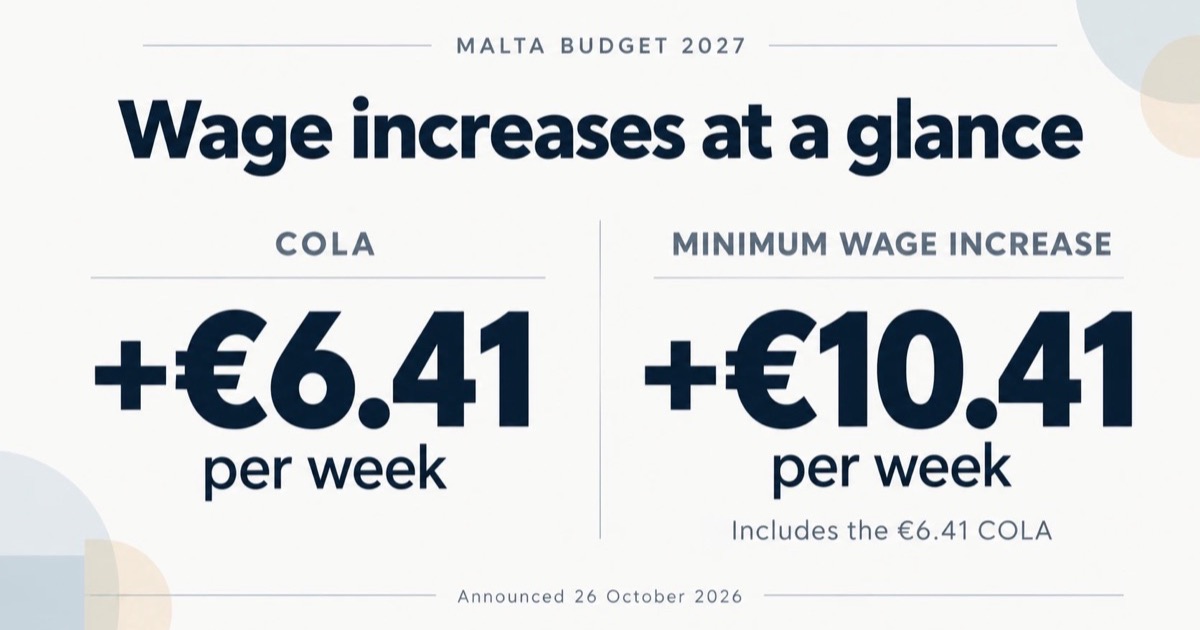
The announced cost-of-living adjustment for 2027 is €6.41 a week. The national minimum wage is to increase by €10.41 a week, a figure that already includes that adjustment.
These changes are relevant to departures being negotiated towards the end of 2026. An agreement reached in December may involve employment, notice or salary-related payments extending into the following year. The calculation should identify the applicable rate for each period and the basis of each payment.
Employers and executives should distinguish salary during continued employment, notice payments, accrued entitlements and any additional negotiated compensation. A single settlement figure can obscure the assumptions used to arrive at it. The Act also defines the wage base for particular termination payments, making the treatment of individual remuneration components important. Reviewing a proposed exit agreement in Malta explains how to test each component.
There is a further point for new executive appointments. The statutory twelve-month probation category for technical, executive, administrative and managerial positions includes a wage threshold linked to twice the national minimum wage established that year. Relevant engagements should be checked against the applicable threshold and any agreement for a shorter period.
Public benefits can influence recruitment and retention
The proposed changes to public transport and childcare may affect the household costs of employees considering a move to Malta or deciding whether to stay.
From January, the speech proposes retaining free public transport for Maltese citizens, resident EU citizens and long-term residents. For free childcare, existing users are to retain eligibility until their children cease to qualify, while access for new users is to be restricted to the stated categories.
Residence status and transitional protection will therefore matter. Employers should avoid making general assumptions about all non-EU staff and should check the position before describing the benefits available to a prospective recruit.
For businesses offering relocation or family support, this is also an opportunity to review the wording of offer letters and benefit policies. The distinction between a public service and an employer’s contractual promise should be clear. Any decision to introduce transport or childcare support should specify eligibility, duration and what happens when employment ends.
The Super Bonus raises questions for employees leaving employment
The Government plans to pay the Super Bonus in the first quarter of 2027, using 2025 as the base year. The speech provides for a non-taxable €1,000 payment for eligible persons with employment income of at least €12,000, with lower payments under the stated income bands. It also includes self-employed persons, part-time workers and older people who continue working.
The base year is relevant to employees who have since resigned, been made redundant or retired. Their position will depend on the complete eligibility rules, including any residence and administrative requirements. The speech does not establish a requirement to remain with the same employer until payment.
In exit negotiations, the public payment should be considered separately from contractual bonuses and the employer’s settlement obligations. Parties should establish the basis of any entitlement before attributing a value to it or assuming it can reduce an agreed payment.
Retirement-related exits require individual calculations
The Budget reaffirms that retirement age and social-security contribution rates will remain unchanged. It announces a €10 weekly pension increase, including COLA, and an increase in the pension-income tax-free limit to €37,624.
These measures may affect the income assumptions behind a retirement-related departure. An executive considering an agreed exit should establish when pension entitlement begins, the expected income and any period requiring separate funding. State-pension measures and benefits under an employer’s own arrangements should be assessed separately.
The continuing changes to parent tax bands may also affect the net value of taxable payments. Their effect depends on eligibility and the nature of the payment. A negotiated departure should be evaluated using the individual’s circumstances and the applicable tax treatment.
Preparing for 2027
Employers reviewing their workforce should now update recruitment and retention budgets, identify the permit categories affected and revisit the salary assumptions used in proposed exits. Where technology investment will change roles, the business plan should address training, contractual changes and the treatment of affected employees.
For executives negotiating a departure, the corresponding task is to make the components visible: the salary rate, notice arrangements, benefits ending with employment, pension access and any separate public entitlement. A clear calculation gives both sides a firmer basis for agreeing the terms of an exit as the detailed Budget measures take effect.
For senior executives, an early review can test the salary, notice and pension assumptions behind a proposed departure. See executive exits.
For employers, advice can help plan a reorganisation, redundancy or automation project that complies with Maltese law. See workforce restructuring.
To discuss a proposed departure or restructuring, send a confidential enquiry.
The law changes, so please check the current position with an advocate before acting.