
Malta's iGaming sector is changing: restructuring, redundancies and executive exits

Malta’s gaming industry remains economically significant. Yet consolidation, European regulation, taxation and technological change are altering how operators organise their businesses. For senior executives and employers, the employment law consequences deserve attention before decisions are finalised.
Growth does not rule out redundancies
The latest official figures do not describe a collapsing industry. According to the Malta Gaming Authority’s (MGA) 2025 Annual Report, Malta’s gaming sector generated an estimated €1.422 billion in gross value added, about 6.3% of national economic output. The industry supported an estimated 19,150 direct and indirect jobs, while employment in Malta with MGA-licensed businesses reached about 15,039 full-time equivalent positions, an increase of 4.8% over 2024.
Those figures, however, conceal an important shift. Employment on MGA-licensed online activities fell from 10,305 in 2024 to 10,115 in 2025. By contrast, employment associated with activities licensed in other jurisdictions, or with services provided through related companies, rose from 3,156 to 3,974. These are categories the MGA reports. They are not measures of redundancies.
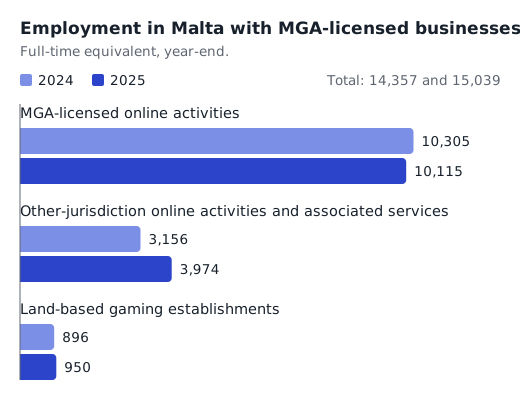
Source: Malta Gaming Authority, Annual Reports 2024 and 2025. Employment in Malta associated with MGA-licensed businesses at year-end, using the MGA’s categories. The online categories separate activity licensed by the MGA from activity licensed elsewhere and associated services.
The distinction matters. A growing sector can still contain operators that merge departments, relocate functions, automate tasks or remove management positions. Growth in employment across the industry says nothing conclusive about whether a particular dismissal is justified.
Why the operating environment is changing
European regulation is increasingly national in its application. There is no single EU gambling licence: Member States keep substantial freedom to regulate gambling services within the limits of EU law. A Malta-licensed group operating across Europe may therefore need separate authorisations, compliance arrangements and commercial strategies for different markets.
Germany is an example. Its Joint Gambling Authority of the Länder keeps an official list of authorised providers. Austrian reforms, notified to the European Commission in August 2026, propose a new online concession framework alongside internet and payment blocking. As at October 2026, those Austrian measures remain proposals, not enacted law.
There is also direct pressure on parts of Malta’s framework. In June 2025, the European Commission opened infringement proceedings over Maltese provisions requiring courts to refuse recognition and enforcement of certain foreign judgments against Malta-licensed gaming companies. This concerns cross-border civil litigation. It is not a general finding that Malta’s gaming licences are invalid.
Fiscal pressures are substantial in some destination markets. The Netherlands raised its gambling tax rate from 30.5% in 2024 to 34.2% in 2025 and 37.8% in 2026. Its gambling regulator reported that the regulated online market’s gross gaming result in 2025 was about 18% below 2024, with several regulatory and commercial factors at play. The figures show how much local taxation and player protection measures matter commercially. They do not show that the Dutch reforms caused any specific redundancy in Malta.
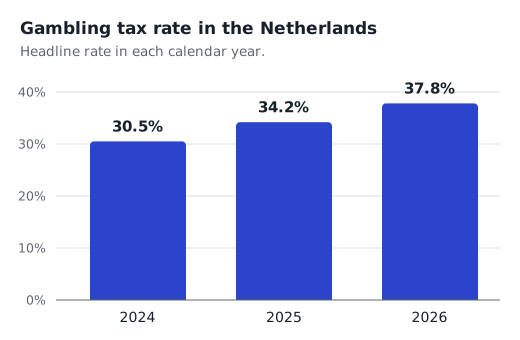
Sources: Statistics Netherlands (CBS) and the Netherlands Tax Administration (Belastingdienst). Headline Dutch gambling tax rate, 2024 to 2026. These are Dutch rates, not Maltese tax rates.
Malta has also responded to competitive pressure. Revised gaming tax and VAT arrangements took effect on 1 October 2026, intended to give operators more clarity and predictability. Their effect will have to be assessed over time.
Technology adds another dimension. AI can change staffing needs in customer support, content, marketing, risk analysis and operations. Whether those changes justify a particular redundancy is a separate legal question. It is wrong to assume either that every job loss linked to AI is unlawful or that citing AI makes a dismissal lawful.
International restructuring, Maltese employment obligations
A group headquartered abroad may decide to consolidate regional marketing teams, outsource support functions or centralise compliance oversight. Its Malta subsidiary may have little influence over that commercial decision. Employees engaged under Maltese contracts nevertheless keep the protections that apply to their employment.
The first legal task is to identify what is actually happening: a genuine redundancy, a reassignment, a transfer of an undertaking, an agreed termination, or a dismissal described as a restructuring. Each can carry different obligations and risks. Is it redundancy or dismissal? explains how the Industrial Tribunal draws the line.
Under Maltese law, selection for redundancy follows the last in, first out principle within the relevant class of employment. The correct classification, the substance of the roles that remain and the facts behind the selection may all matter. Where the statutory thresholds for collective redundancies are reached, employers must also follow the information, consultation and notification procedures. Consultation is meant to consider avoiding redundancies, reducing their number and softening their consequences. It is not a formality after the decisions are announced.
The Department of Industrial and Employment Relations publishes the thresholds and procedural requirements.
When a senior executive’s position disappears
The situation is particularly sensitive for a CEO, country manager, chief marketing officer, head of compliance or other senior executive whose position is removed after an acquisition or reorganisation.
The legal analysis goes beyond statutory notice. It may need to cover contractual termination provisions, bonus arrangements, deferred remuneration, equity awards, directorships, garden leave and restrictive covenants. Where the executive holds a regulated key function, regulatory notifications and the continuity of those responsibilities may also need attention. Preparing for an executive exit sets out the points to review.
An employer may propose a mutually agreed departure instead of a contested redundancy. Such agreements can give both sides certainty, but an executive should understand which entitlements and potential claims are being given up, and whether confidentiality, non-disparagement or post-termination restrictions remain proportionate. Reviewing a proposed exit agreement covers the main terms.
A request to sign a resignation letter deserves particular scrutiny when the real reason for leaving is that the employer has removed the position. Resignation, redundancy and negotiated termination are not interchangeable descriptions. The label used can affect contractual rights, legal claims and the agreed public explanation of the departure.
Malta does not provide a general, automatic statutory severance payment on redundancy. Contractual rights, statutory entitlements and any enhanced settlement should therefore be assessed separately. An employee alleging unfair dismissal generally has four months from the dismissal to refer the matter to the Industrial Tribunal, so early advice matters.
For employers: plan the legal process before announcing the result
For gaming operators, the central challenge is to turn a legitimate commercial strategy into a lawful and workable Maltese employment process.
Before communicating proposed changes, boards and HR teams should assess the employing entity, the functions actually being discontinued, the right selection pool, the consultation obligations, the options for redeployment and the contractual position of affected executives. International groups should take particular care not to assume that a process acceptable elsewhere can be run unchanged in Malta. Planning workforce restructuring in Malta takes these steps in order.
Well-documented decisions and credible consultation can reduce disputes. For senior departures, a properly negotiated agreement can also protect confidential information, the continuity of regulated functions and the business’s reputation.
The NetEnt experience: consultation and negotiation can change the outcome
Malta has already seen what major iGaming consolidation can mean for staff. After Evolution acquired NetEnt in 2020, a proposed large-scale redundancy exercise led to a legal and industrial dispute with the General Workers’ Union (GWU), which Dr Aron Mifsud Bonnici advised in the negotiations.
The negotiations produced an improved package for the affected employees, and the union then withdrew its injunction application.
An initial redundancy announcement or exit proposal need not be the final outcome. The legal framework and the quality of the negotiations can materially change the terms on which a restructuring is carried out.
Advice on executive exits and workforce restructuring in Malta
The pressures on Malta’s gaming industry are real, but the official figures do not show a wave of redundancies across the sector or identify the cause of any particular termination. What is clear is that business transformation leads to decisions with substantial employment law consequences.
For senior executives, an early review can clarify termination rights, potential claims and the scope for negotiating a better departure agreement. See executive exits.
For employers, advice can help structure a redundancy or reorganisation that complies with Maltese law, while managing contractual, regulatory and reputational risk. See workforce restructuring.
To discuss a proposed departure or restructuring, send a confidential enquiry.
The law changes, so please check the current position with an advocate before acting.